
Principal Dentist
Dr. Charlotte Hing
BDS (PIDC) · PGDip Endodontics (IMU)
Carries out root canal treatment under magnification, including the cases where a canal was missed the first time and the tooth has never fully settled.
When the nerve inside a tooth becomes infected, the choice is usually between treating it and losing it. Root canal treatment clears the infection from within and keeps your own tooth in place.
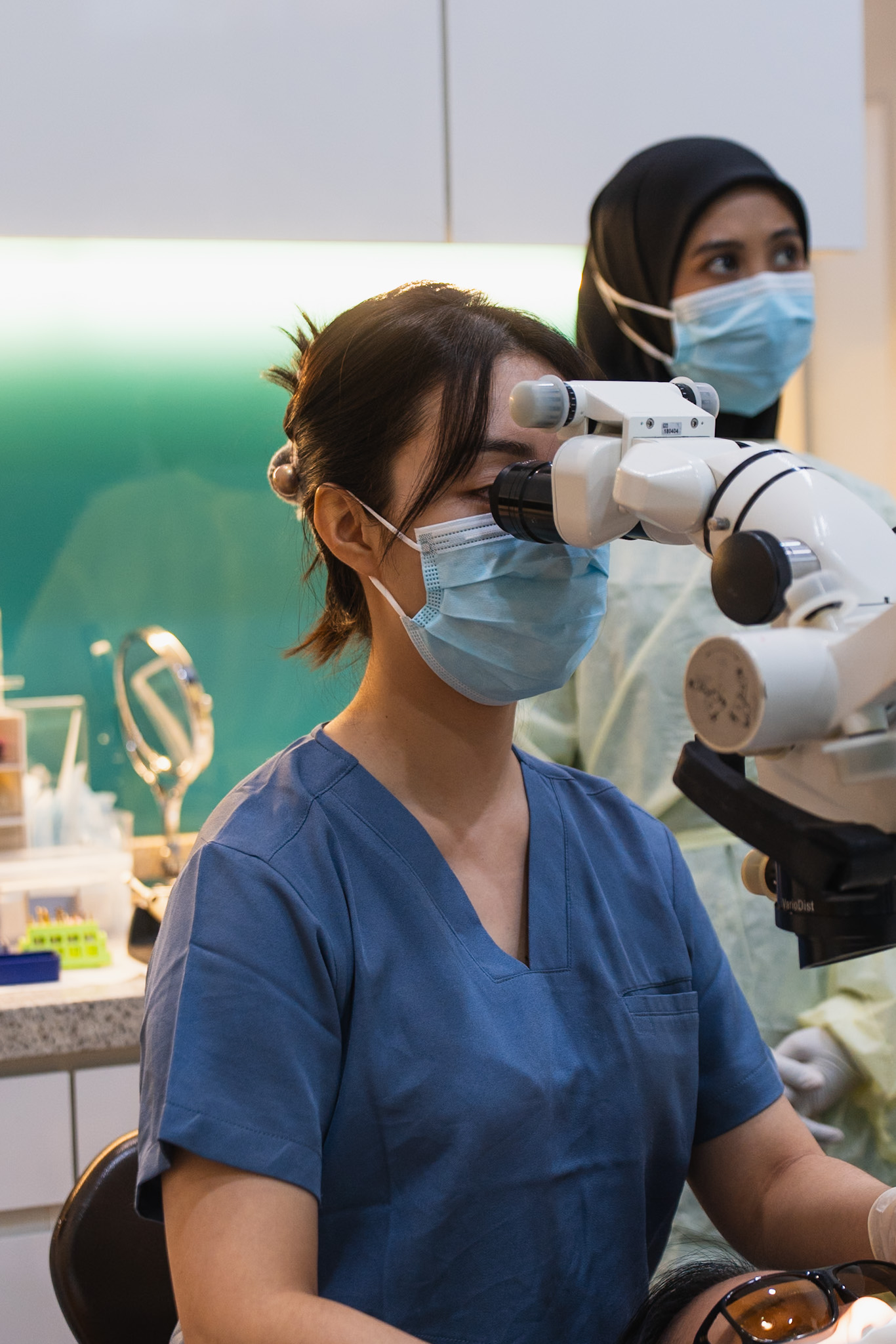
Root canal treatment at Wong & Sim Dental is provided by clinicians with specialist & postgraduate training in endodontics, supported by the use of surgical operating microscopes for enhanced precision and visibility.
More complex cases — including dental trauma, unusual root canal anatomy, or previously treated teeth requiring retreatment — can be referred within our team and to our specialist endodontist for further management.
BDS (PIDC) · PGDip Endodontics (IMU)
Carries out root canal treatment under magnification, including the cases where a canal was missed the first time and the tooth has never fully settled.

BDS (AIMST) · PGDip Endodontics (IMU)
Treats the canal and then rebuilds what is left of the tooth around it, working to keep as much sound structure as possible rather than reducing the tooth for a crown by reflex.

BDS (AIMST) · MDS Endodontics (HKU)
Takes on the referred cases — dental trauma, teeth with incompletely formed roots, calcified canals and treatments that have failed elsewhere.
Inside every tooth is a soft core of nerve and blood vessels, running from a chamber in the crown down through narrow canals in each root. Deep decay, a crack, repeated fillings or a knock to the tooth can let bacteria reach that core. Once they do, the tissue cannot recover on its own.
Root canal treatment removes the infected contents, disinfects and shapes the canals, then seals them so bacteria cannot re-enter. The tooth stays where it is, held by its own root, and continues to function.
The signs are not always dramatic. Lingering pain after something hot or cold, an ache on biting, a tooth that has darkened, a gum boil that comes and goes, or swelling around the jaw all warrant an examination. Some infected teeth stop hurting entirely, which is not the same as getting better.
Left untreated, the infection spreads through the root tip into the surrounding bone. At that stage the realistic options narrow to treatment under more difficult conditions, or removing the tooth and later replacing it with an implant or a bridge.
Keeping a natural tooth is almost always simpler and less costly over a lifetime than replacing it.
We use surgical operating microscopes during root canal treatment to manage complex anatomy and canals that are difficult to reach. Painless injections and safe, precise treatment under magnification make the appointment comfortable and the outcome predictable.
“Careful cleaning and a well-sealed canal matter far more to long-term success than how quickly the treatment is finished.”
Canals are narrow, curved and often branched. Some molars carry an extra canal that sits hidden under a shelf of dentine and is easy to miss with the naked eye — and a canal that is missed is one that stays infected, which is the most common reason a root canal treatment fails.
Under high magnification and coaxial light, those openings become visible. Fractures can be identified before treatment rather than discovered afterwards, and only the tooth structure that has to go is removed.
Comfort is dealt with before any treatment begins. Topical gel numbs the gum first and the anaesthetic is delivered slowly, so the injection itself is barely felt, and we confirm the tooth is fully numb before starting. Most patients find the appointment far easier than they expected.
Treatment is carried out under rubber dam, a thin sheet that isolates the tooth. It keeps saliva and bacteria out of the canals during cleaning and stops irrigating solutions and small instruments from reaching the rest of your mouth.
Which of these applies depends on the state of the nerve, how much tooth remains, and whether the tooth has been treated before.
← Swipe to view options (01 – 07) →The standard treatment for a tooth whose nerve has become irreversibly inflamed or infected. The canals are cleaned, shaped, disinfected and sealed, and the tooth is then rebuilt.
For a tooth treated previously that has stayed sore, flared up again, or shows infection on a radiograph. Old filling material is removed, missed or untreated canals are located, and the system is cleaned and sealed again.
Some teeth arrive with a difficulty already inside them — an instrument separated in a canal, a canal that has been blocked or ledged, a perforation through the root wall, or a post that has to be removed before the canal can be reached again. Under the microscope, most of these can be dealt with and the tooth kept.
When you arrive in acute pain or with swelling, the first appointment is about settling it. The inflamed tissue is removed and the tooth dressed with intracanal medication, which usually relieves the pain quickly, with the full treatment completed afterwards.
Baby teeth and newly erupted adult teeth are handled differently. In children the aim is to keep the tooth in place until it is due to be lost, or to let an immature root finish developing before anything more is done.
Where infection persists at the root tip and conventional retreatment is not possible or has not worked, the tip of the root and the surrounding infected tissue can be removed through a small procedure at the gum, and the root end sealed.
A treated back tooth is more prone to fracture and usually needs full coverage — an onlay or a crown — to protect it. How much healthy structure is left decides what it needs, and we remove as little of it as possible.
Share your needs with us and our team will be in touch shortly. Every treatment journey begins with a conversation.